
History
The early days
The Byre was founded in 1933, by local freelance journalist and playwright, Alexander B Paterson. The auditorium in the current building is named after him and shows how far the theatre has come since its humble beginnings as a semi derelict cow byre.
Renovations were carried out with the support of Hope Park Church’s theatre group and the building was leased from the Council for £10 per annum.
This marked the beginning of the St Andrews Play Club, which remains active and stages performances on the Byre stage to this day.
Eager to improve their theatrical skills, the company used theatre profits to send Russell Mather to Edinburgh Drama College as a full time student from 1937 – 39, on the understanding that he would teach what he learned during the week to the Play Club members at weekends. Russell had barely completed his course when war broke out and he joined the army.
Play Club activities were paused when most of the company entered active service. In 1939, the Dundee Repertory Company, under the leadership of Robert Thornley, had a six-week season at the Byre while its theatre was being reconstructed.
In spring 1940, Elliot Playfair, Hugh (Hastings) Williams, Douglas Storm, Edith Ruddick, Flora Britton and Pauline Reeves formed the first St Andrews Repertory Company. They enlisted the help of Charles Marford, former stage manager at The Old Vic Theatre in London, who managed the theatre under difficult circumstances until 1945 when A. B. Paterson returned from the RAF and Charles Marford handed management of the theatre over to him.
The Byre’s second building
In 1964, Friends of the Byre was formed in anticipation of a new theatre building and Jenny Rodger was appointed as President. On the advice of A. B. Paterson, architect Mr T. P. Rodger visited the Mermaid Theatre in London and used it as a basis for the new Byre Theatre which would be erected on a site thirty yards north of the original.
In 1969, after more than 30 years and numerous productions, the original Byre Theatre was demolished. The final performance was The Grouse Moor Image by William Douglas-Home on 3rd January. The curtain was left open at the end of the performance to symbolise a flow of continuity into the new building.
With funds raised by a public appeal and the local authority, the new theatre building was opened for approximately £40,000 in 1970. The opening performance was A. B. Paterson’s version of Weir of Hermiston. The theatre’s facilities were modest, for both public and staff, but it was a vast improvement on what had existed before. The new building could hold 140 people, doubling the old Byre’s capacity.
Before his death in 1989, A. B. Paterson wanted to modernise the Byre Theatre yet again. His vision was for the building to meet the requirements of a new generation.
The Byre’s third building
The Byre Theatre, as it stands on Abbey Street today, cost £5.5 million to build. Designed by architects Nicoll Russell Studios of Broughty Ferry, the building has fulfilled A. B. Paterson’s final wishes. The building opened in 2001 with a critically acclaimed performance of Into the Woods.
The theatre continued to thrive until January 2013 when it went into liquidation after experiencing financial difficulties.
The Byre Theatre officially reopened its doors once again in October 2014 thanks to a management agreement between the University of St Andrews, Fife Council, and Creative Scotland.
Jack and the Beanstalk, written and directed by Gordon Barr (Artistic Director of ‘Bard in the Botanics’), was the first professional production to take place following the reopening, following runs by the St Andrews Play Club and student group, Mermaids (University of St Andrews’ Performing Arts Fund).
In 2021, following a difficult year due to the impact of the Covid-19 crisis, the Byre celebrates 20 years in its current, award-winning building.
The Byre Theatre continues to be a diverse and culturally vibrant home for all the people who live, study, work and play in St Andrews and beyond and is a platform for artistic, creative, engaging and learning experiences that nurture and enrich the lives of our communities.
For more information, please click here to visit our Archive.
About Us
Just ask!
For anything that you can’t find on this website, please call the box office on 01334 475000.
Alternatively, reach us via the Contact page.
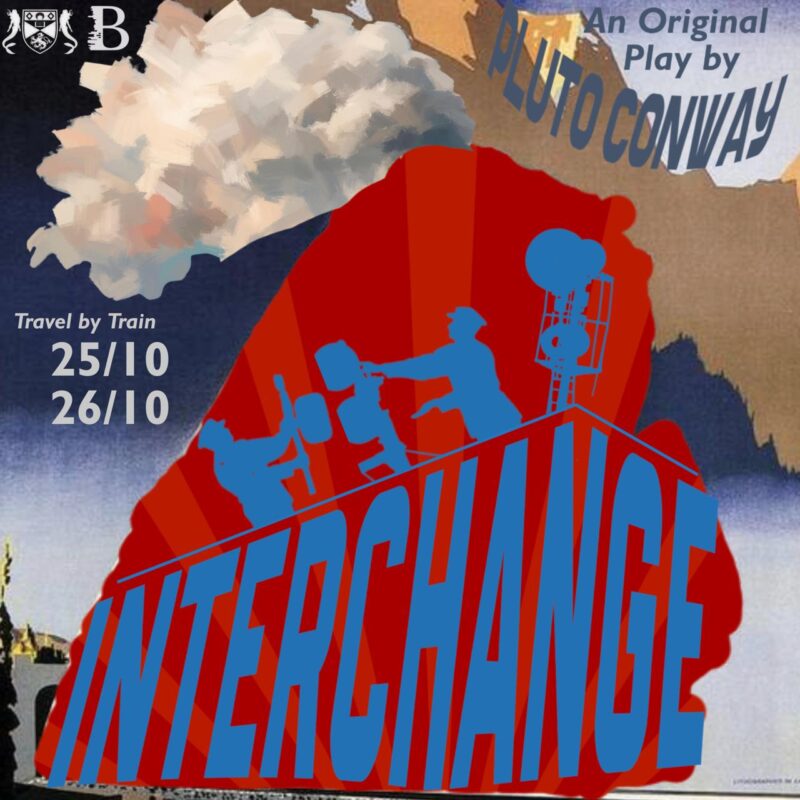
Mermaids present Interchange by Pluto Conway
Sunday 25 October and Monday 26 October 2026
FIND TICKETS >